Kurt Klappholz

Kurt Klappholz

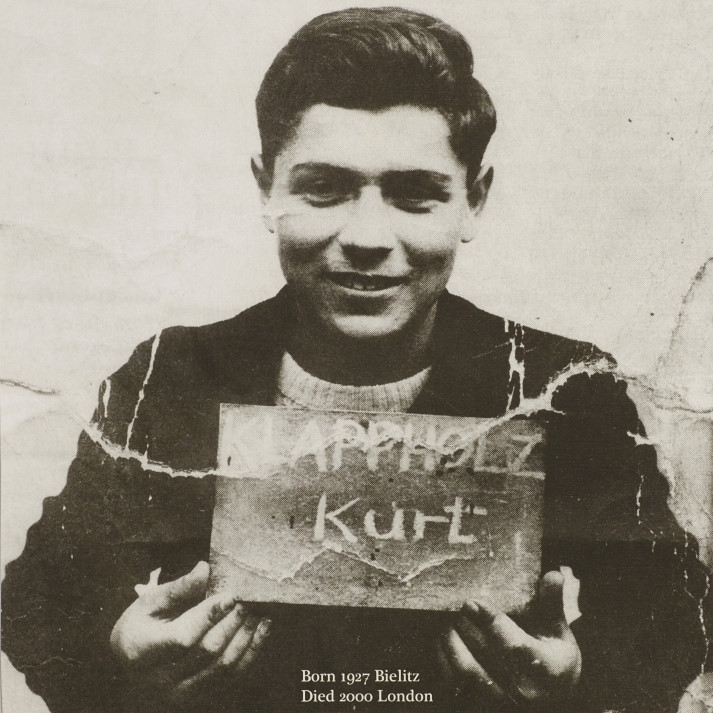
Kurt Klappholz was born in Bielsko, Poland, on 17th June 1927. The only child of Moritz and Sonia Klappholz, he had an idyllic childhood before the Germans occupied Poland.

This photograph was taken a few months after liberation. My Papa had only just recovered form a bout of typhus which had nearly finished the job the Germans had started. This picture captures the very essence of him, his innate curiosity and genuine warmth and love for humanity, despite his horrendous wartime experiences. Almost all of our family were murdered.

Adam Klappholz

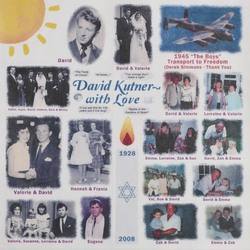
David Kutner

tbmq-079David Kutner, survivor, was all about love.

His great love for the sun in both summer and winter, for the full moon, for his favourite Spanish music, for his funny little sayings, for the stories of the Fools of Chelm and for his daily cups of tea.


He also loved his many friends like Sala and Benny, fellow survivors, ”interferers” at his wedding in lieu of his lost parents. Or Joyce and Eddie from the Primrose Club days.

All of these are represented on our Memory Quilt square.
But most of all, David’s love was for us, his family: Valerie, his beautiful, loving and caring wife; Lorraine and Suzanne, his adored daughters, and Emma and Zak, his treasured grandchildren.

Also for Frania, his late sister, who he found after the War but later sadly lost in 1964, and for Frania’s children, Hannah and Eugene, who, although many miles distant, were always in his heart.These photos are a tribute to the love he gave all of us.

Finally, a word about the Lancaster Bomber and Mr. Derek Simmans, who, with Valerie, first met David in October 2007. Derek was so moved by David’s Holocaust experiences that he helped us to get all his testimony to Yad Vashem. It was Derek who suggested the brilliant idea of the Lancaster Bomber to remind us all of The Boys’ new start in life. We thank him here personally in David’s name.

May the sun always shine on the glorious memory of dear David.

Suzanne Kutner
Jack Melcer

Jack Melcer

I was born in 1930 in Warsaw. I had a sister and 3 brothers. I lived in the ghetto until mid 1941. I managed to escape together with my mother to Kozienice. I had to go to farms and beg for food. A Volksdeutche farmer’s wife offered me a job which I accepted on condition that my mother will also get some food.

When the Germans liquidated the Kozienice ghetto, I missed the train. I had to walk to Deblin ghetto where I found cousins to stay with. A few weeks later, the Deblin ghetto was liquidated and we were sent to a working camp just outside Deblin where we worked until the Russian offensive.

We were then moved to Czestochowa. I was lucky to be in the second transport as the children in the first group were gassed. When we heard what had happened, we managed to convince the Germans that we were able to work as adults. We manufactured bullets in 12 hour shifts.

Again the Russian army approached, half the camp was moved and ended up in Auschwitz. Luck was on my side, I was in the second group and we were liberated by the Russians at the end of 1944.

In 1945 I came to Terezin and joined a group going to Windermere where we slowly returned to normal life. I went to a school in London with the help of Sir Leonard Montefiore. I trained as a dental mechanic but then moved on to plastic profiles manufacturing.

In 1965 I married Miriam. We have 2 sons: Jerome, an actuary, is married and has five sons and one daughter. Leonard, an IT Consultant, is married with 3 daughters and lives in Melbourne Australia. I am retired now and enjoy being with my family.

Ethan Rife, a 13 year old from Virginia, chose to remember my little brother Simcha Tova at his Bar Mitzvah and keep his memory alive. We were included in the family celebrations. Ethan became A Guardian of Jewish Memory through the organisation Remember Us.

I chose to list the members of my family who perished in the Shoah as a memorial to them. Below is a photo of my family now, who will PG continue to grow and show that the Nazis did not achieve their aim.

Sam Laskier

tbmq-035My father, known then as Szmulek or Shmuel Laskier, was born in Warsaw in August 1927. His family home was in the middle of the ghetto on Stavki St, across from the Umschlagplatz. After approximately 18 months in the Warsaw ghetto, his parents managed to smuggle him out and he was sent to stay with his Aunt in Ostrowiecz. From there, he was sent to Blizin concentration camp, and from there, to Auschwitz/ Birkenau. After 7 months, he was then transported to Buchenwald concentration camp. After many months, he was sent with many of The Boys to Theresienstadt. There, he was liberated on 8th May 1945 by the Russians. Dad was then helped by the Central British Fund to come to England in August 1945 and was sent with the first group to Windermere in Cumbria.

My father’s younger sister Rushka also survived the camps, and they were reunited in the UK in 1946. Eventually his sister emigrated to Israel where she still lives, together with her husband, 2 children and 3 grandchildren.Dad eventually settled in North Manchester where he met our mother, Blanche. They married in 1956. Initially dad worked in many factories and industries and eventually built a business in wholesale menswear.

This square represents the Laskier family, from before the Second World War to the present day where my father is surrounded by the love of his 4 children and 5 grandchildren, and is in memory of his mother, father and sister (top picture) together with many of his extensive family who perished at the hands of the Nazis.

Shelley Laskier

Peretz Lev

Peretz Lev

Peretz Lev (Levkovich) was born on September 9th 1927 in a small village called Pavienze in Poland. At the age of 6 he lost his father and the family moved to Lodz. He was 12 years old when his family was forced to move to the Lodz ghetto. In 1944 he was transported to Auschwitz Birkenau with his mother and sister. As the war intensified he was moved to Hankel concentration camp in Germany and was finally liberated by the Russian troops during the last death march. After trying to return to his homeland, where Peretz met his older brother Izack, he went to Theresienstadt where he was one of the children taken under the British auspices to England and became one of “The Boys”. In 1949 Peretz was reunited with his mother, his sister and his older brother, who had miraculously survived the holocaust, and the family moved together to the new state of Israel.

In 1951, Peretz joined the Israeli Air force where he served until 1976. After his military service he joined the Association for the Wellbeing of Israel’s Soldiers (AWIS) until his retirement in 1991. From 1991 till today, Peretz still continues with his volunteering activities with the IDF and school children as a spokesperson on the atrocities which the Nazis carried out against the Jewish people during the Holocaust. He always says it is so important “Never to forget.” This square represents Peretz, his love for Israel, the Israeli Air force, the IDF, his family and his victory over the Nazis by his legacy of four children, ten grandchildren and eleven great grandchildren. Peretz lives today in Beer Sheva, Israel with his wife, Yocheved.

Assaf Lev

Rachel Levy

tbmq-048My mother was born on 30th April 1930 in a tiny village called Bhutz in the Carpathian Mountains. The Nazi’s first came to round up the 100 Jews in the village in 1942 but they evaded capture by hiding in the mountains aided by the local Romanians. In 1945 the Nazi’s returned and this time hiding was futile, she was taken to a ghetto with her mother, older brother and 3 younger siblings. Soon after they were transported to Auschwitz where her mother and the younger children were selected and immediately sent to the gas chamber. My mother was separated from her brother Chaskiel who did survive.

After surviving the Death March from Auschwitz to Bergen-Belsen she was finally liberated by British soldiers in 1945 aged just 15 years old.

Miraculously her brother found her and together they were brought as part of ‘The Boys’ to Ireland and then England in 1945. My mother trained as a dressmaker, married Phin Levy and had two children. Today at the age of 84 she still teaches dressmaking.

Shelly Irvine

In the summer of 2013, I had the unique and powerful opportunity to travel alongside my Grandmother into the countryside of Ukraine and rediscover the village she called home as a child. To identify with my personal history through the exploration of physical place was one of the most surreal experiences. As a member of the 3rd generation I, alongside my younger brother, had the rare opportunity to not only hear my Grandmother’s story of survival but to stand beside her as she rediscovered the land on which she was raised.
There are few words that can describe the impact that trip made on me, it went beyond the retelling of a story of survival and became the reclamation of a story of childhood happiness. Survivors are defined by the life changing experience that was the Holocaust, but I hope we as the 3rd generation can carry the stories of happiness and innocence of childhood alongside the stories of sadness, resilience and endurance. This quilt square represents what I pictured in my own mind as my Grandmother described her memories of Behutz to me. A family owned mill alongside a river, nestled in a green valley – a beloved home to my Grandmother.

Hannah Levy House

Steve Mermelstein

Steve Mermelstein

Our father, Steven “Simi” Mermelstein z”l was born on December 9, 1929 in Zdenyov, Czechoslovakia. The situation in his area began to deteriorate in 1943 and his older sisters convinced their father to let them care for him in Budapest where they worked as nurses in the Jewish Red Cross hospital. He was briefly conscripted into a labor camp but was rescued by his sisters and spent the remaining time in hiding in hospital, pretending to have a kidney disease.

After liberation in Budapest on January 10, 1945, Steve discovered his father Itzchak Eizig, sister Hudje and 3 year old niece Reizl were all murdered in Auschwitz. As a teenager, all alone, he was lucky to be included in the group of children brought to England by the Central British Fund in March, 1946. During the interviews, which were in English, a language he did not yet speak, the interviewer told him “All right”. He had no idea what that meant, but he often said that it was the happiest day of his life.

After almost five years in England, Steve emigrated to the U.S. and joined two of his brothers, Bennet and Kalvin, in New York. He went to Fashion Institute of Design, became a pattern maker and moved to Buffalo, New York where he met and married Ella Korman. Steve joined his brothers in 1961 in Los Angeles where they began manufacturing women’s clothing. They expanded their business into real estate development and property management and the business continues today. Steve and Ella had four daughters: Sandy, Elaine, Suzanne and Elisa. Sadly, in May 1975, Steve lost his beloved wife to cancer when she was only 34 years old and was left to raise his daughters as a single father.

The square represents Steve’s life journey and is centred on a map of the world. He was born in Zdenyov – represented by a picture of him with two of his sisters and his niece. He was liberated in Budapest and then moved to London. His move to the United States on the Queen Elizabeth II is represented by the picture of him as a young man next to the image of the boat. The scissors represent his training in London to be a pattern maker. After moving to the U.S., he moved to Buffalo where he met and married Ella Korman. The two of them are shown together. The image of the airplane represents his love of travel. The final two pictures are with his four daughters and his three grandchildren, Aaron, Ella and Noa – his great pride and joy!

Sandy Mermelstein

Sala Hochszpiegel & Benny Newton

Sala Hochszpiegel & Benny Newton

My parents were born in Poland in 1929, my mother Sala in Lodz and my father Benny in Skarzysko. Their war years were spent in various ghettos and camps, both finally ending up in Theresienstadt from where they were liberated on 6th May 1945. They were brought to Windermere where their relationship blossomed and they eventually married on 6th May 1951, settling in Cricklewood, in north west London.They were affectionately known as Shaindl and Shaiah by their friends. The essence of their survival is their family, having been blessed with 3 daughters, 9 grandchildren and 12 great-grandchildren.

Rosalind Landau

Moshe Nurtman

Moshe Nurtman

The Nurtman Family square features a rainbow which represents the life and hope that was born from so much hate. The names above the rainbow are those of Moshe’s parents, brothers and sisters who perished in the Holocaust and: Israel (44 years), Sarah (38 years), Benjamin (18 years), Esther Brandel (16 years), Samuel (11 years) and Rose (8 years). Their names shall never be forgotten. The 6 candles commemorate the 6 million who died.

The rest of the square represents Moshe’s pride and joy: the names of his three sons – Howard, Saul and Mickey and the handprints of his grandchildren – Alex, Lexie, Joelle and Samuel.

Moshe came to London in 1945 and was in the textile industry. He loves Turkish Baths and playing cards. One of Moshe’s memories is of his mother buying doughnuts for the family whenever there was a family occasion. These doughnuts are represented on our tree of life.

Victoria Jossel

Chaim Lewkowicz

Chaim Lewkowicz

Born on 21st February 1926, the youngest of eleven children, to Yaakow and Chava, Charlie (then known as Chaim) grew up in Pietrkow Trybunalski, Poland. After surviving several concentration camps, he came to England as one of The Boys. He married Beca and had two children, Eve and Jack, and six grandchildren: Jonathan, Robert, Ilana, Sharon, Steven and Samantha.

Charlie managed a factory in the east end of London, manufacturing shoulder pads and was a member of Palmers Green & Southgate shul for many years. He and Beca loved to entertain their ‘survivor’ friends and spent many evenings playing cards – the women played Kaluki while the men played Poker!

A real life hero, at his shiva, three friends came forward and told stories of how he had saved them during the war. One friend told of how Charlie had carried him home from a day’s labour at the Ammunitions Factory – they would have shot him had he been unable to walk. Another told how Charlie had given him his portion of food when typhoid broke out in Theresienstadt at the end of the war. Camp staff were too afraid to come near with food. Chaim had saved some bread and gave it to him. Always a kind and generous man!

Eve Pearl