Alec Ward

tbmq-113

Alec was born (Abram Warszaw) in Parysow near Lublin, Poland, and lived mainly in the village of Magnuszew. He survived two ghettos, three slave labour camps and two concentration camps and was liberated from Mauthausen by the Americans on 5th May 1945. Alec’s entire family perished during the war but the shooting of his younger brother Laib (aged just 9), who he protected for three months in the forest following their escape from the ghetto, had a particularly profound impact on him.
Alec came to England in October 1945 and became a tailor and then a quality controller for Windsmoor. He fell in love with Hettie Cohen in 1952 and married in 1953. They had two children, Lyla and Mark, who died in 1981 aged 23 of melanoma. Alec adores his grandson Liron, named after Laib and welcomed his son in law Barend and his children into the family.

Music is a thread running through Alec’s life. As a child he enjoyed singing at home and in the synagogue and remembers being embarrassed when his mother called in the neighbours to hear him singing when collecting potatoes from their cellar. He has fond memories of klezmer music at weddings and classical music at skating rinks. He also remembers a soldier who came to a Friday night service singing “Lecha Dodi” beautifully and perpetuates the memory by singing this melody when he is called up to the Torah. In the ghetto he smuggled in cigarettes to sell, attracting customers by singing songs like “Papierosen.” “If you buy my cigarettes you will rescue me from certain death.”

In the camps he formed a friendship with a boy with a wonderful voice and they would sing together to soothe themselves. Alec made this friend a hat from scraps of blanket and twisted yarn that he collected from the handles of boxes he carried for work. In Buchenwald, when lining up for roll call dressed in a thin striped uniform, he would hear the inmates’ orchestra. Alec has always been perplexed by the psychology behind the cruel disconnect of music with inhumane conditions. But following retirement, listening to music and gardening has given Alec pleasure and comfort.

Alec has given talks to synagogues, schools, and many other settings, to speak about his experiences and to create witnesses to his testimony. He always tried to include some songs including “Papierosen” and would end with the words “I implore you not to hate as it was hatred that caused the Holocaust in the first place. Had I lived with hatred in my heart for the last 60 odd years I would not be here today.” This has inspired generations of all ethnicities and faiths.

Layla Ward

Jerry Wegier

tbmq-118

Jerry’s journey is represented by four playing cards. Follow the cord to see the order of the journey. Jerry and his parents had to leave their home in Radom, when he was 8 years old, hence the Polish flag and photo on playing card, showing No. 8.

The cord then snakes right to the Russian flag, where he survived, with his mother, until the age of 15. As there were no photos from this time, we used a Tea Bag to represent the tea bushes where he and the other children had to pick tea leaves. The cord then veers left to the British flag, where he lived from after the war until the age of 63. The photos are of his wedding to Mildred (Helen) Solomon and his three children, Suzanne, Michael and Ruth. The cord then goes to the right to the Israeli flag. His three children had previously settled in Israel and he and Mil joined them in Jerusalem, where they were blessed with eleven grand-children. The upper photo shows all of the grandchildren. We used playing cards to show his age at the various stages of the journey, as he was a champion Bridge player and Bridge was his greatest hobby. He greatly enjoyed his time in Israel but sadly passed away at the age of 67.

Regretfully, he did not live to meet his great grandson, and namesake, Eitan Yisrael. The second photo, below that of all of the grandchildren, is of his eldest grandson Eliyahu, with his wife Hodaya, who designed the square, despite coming into our lives several years after his passing, together with great grandson Eitan Yisrael.

Mildred Helen Wegier, Suzanne Farber,

Michael Wegier and Ruth Nachinson

Michael Stern

tbmq-061

Moszek and Fajga Szternfeld lived in Zgierz and had four sons: Bolek (b1924), Mietek, my dad (b1927), Jakob (b1930) and Falk (b1934). Mietek’s childhood memories revolved around his grandmother Sarah and horse riding with his father, wearing his treasured riding boots.The whole family was registered in the Lodz ghetto in 1941. His parents died in 1942. His two younger brothers may also have perished then but no record has yet been found.
Bolek and Mietek were sent to different slave labour camps, not meeting again until 1944, when they were on the same train to Auschwitz. They agreed to jump: Mietek succeeded, Bolek didn’t and dad believed his older brother died that year. Surviving this train escape he was eventually recaptured, taken to Buchenwald and then Theresienstadt where he was liberated in May 1945. Overcoming typhoid, Mietek was lucky enough to be on the first RAF plane of survivors allowed into the UK.

Life began again in Windermere and subsequently Montford Hall, where he met his future wife, Marion Maxfield. Before that happened, the Red Cross arranged for Mietek to join an uncle, that he didn’t know, in the USA, but they did not gel and he left to join the US Army.

Now a US citizen, Michael Stern travelled back to the UK and married Marion in 1951. They lived first in the USA, returning to England in 1956, and lived close to Montford Hall.

In 1958, Michael discovered that Bolek had actually survived. He lived near Tel Aviv with his wife Itka (another survivor) and their three children.
A massive heart attack killed my dad on Yom Kippur 1995. Never overtly religious, he prayed for his family and gave thanks for his life every single day. He left behind a loving wife, an eternally grateful son, a caring daughter-in-law and two beautiful granddaughters.

Kim Stern

Avram Weinstock

img_167Avram or as he is known to all his friends – Romek was born on 5th October 1927 in the village of Okocim in Poland to Marcus and Betsha. He and his brother Zvi were sole survivors of the family of eight. After liberation, in April ’45, the two brothers arrived at a DP children’s centre at Kloster Indersdorf where their new life began. Later, they joined the group of orphans going to Northampton, England, better known as “The Boys”.

When the state of Israel was founded, Avram felt he needed to get to the Jewish state and make a free life in a new homeland. He arrived in 1949 to join the air force, based on his background of slave working for the German war industry. After he left the air force he joined a company, which, at the time, was new: EL AL Israel airlines and he stayed working there most of his working life. While working for the airliner, he travelled the world visiting all The Boys who had been his close friends.In 1954 Avram married Elka and had three children and later ten grandchildren and one great grandchild. He continued to work for EL AL while being relocated to different sites across the globe. One of the sites was the UK where he kept up close connections with good friends.

Avram passed away in his sleep at the age of 86.
Today, some of the children of The Boys, the second generation and even the third generation keep close ties.
The shape of the grapes in the quilt resembles two items. First it is from the name: Weinstock but mostly it is to show that even if the Germans, at the time, tried to destroy the Jewish nation, they were unsuccessful. The Weinstock family continues and flourishes.

Motty Weinstock

Weir Courtney

tbmq-108I chose to make this square for everyone at Weir Courtney, Lingfield, Surrey, as a token of my gratitude for all their loving care and support they gave all the youngest children who were brought over with The Boys.

Weir Courtney was one of many hostels which were opened to receive the youngest camp survivors. The emphasis at first, not surprisingly, was on food and medicine. Meals were large and very regular. The emotional needs of the children were harder to satisfy. The Matron of Weir Courtney, Miss Alice Goldberger, and her staff devotedly cared for the children from the day they arrived in 1945 until their departure for a new home in London in December 1948.The six women in this square were so special because they became our surrogate mothers. In particular, Alice Goldberger was a truly unique individual who dedicated herself to the wellbeing of all us children from the concentration camps. Alice herself had fled Germany when Hitler came to power and had studied under Anna Freud. She was devoted to all the children under her care at Weir Courtney. When the children arrived, they were full of hostility, fear and distrust. They were all wild: they were scared of dogs, particularly the Alsatian dogs, they had to be taught how to eat and to understand that their food would not be taken from them.

Despite the circumstances of getting there, for many these were the happiest years – certainly for me this is true.

Zdenka Husserl

Ivor Wieder

tbmq-133

Our father Ivor Wieder was born on April 6th 1931 in Barsna, Romania. In 1944 he was taken to Auschwitz and went on to Belsen until he was finally liberated in 1945, probably one of the youngest inmates to survive. He was brought to England in 1946 and started a new life, firstly in Gateshead Yeshiva for 2 years and then becoming a sewing machine mechanic before entering the luggage industry in 1952.

The square represents his love of learning, Klezmer music and his over 50 years working in the luggage industry.

Simon Wieder

Ernest Sunog

tbmq-061

Ernest Sunog was born in Munkacs on August 15, 1928. He was taken to the concentration camp at Auschwitz probably in 1944. Prior to liberation, he was fortunate to survive one of the death marches. He was liberated by the American army and then narrowly escaped being trapped in Eastern Europe by the Russians. Of his immediate family, his sister also survived, but his parents and older brother did not.He arrived in the UK sometime in 1945, where he became one of The Boys and was fortunate and thrilled to be reunited with two childhood friends from Munkacs, David Herman and Alex “Sanyi” Abramovic. He talked often of playing football with the boys and, believing that the level of football in Australia was not very competitive, he contemplated moving there to play professionally. Instead, he moved to New York City and was introduced to my Mother, Olga (also a survivor), by Gabe Kallos, who is Olga’s first cousin and is also one of the boys.

He lived with his wife and three sons in Queens, New York, until he retired, after which he divided his time between New Jersey and Florida. He passed away on March 10, 2008 and is survived by his wife, his children and their wives, and two grandchildren. His quilt square depicts his professional life, most of which was spent as the proprietor of several children’s shoe stores; the joy he had playing tennis; his love for the State of Israel; and his only true passion, his family.

Ron Sunog

David Wiernik

tbmq-040

David was 15 and living in the town of Lodz in Poland when the war started. Hearing the Germans were rounding people up for deportation, he secreted his family in a high loft while he himself hid in a sewer. He saved seven people from certain death. Some of the relatives are still alive today.

David had many narrow escapes; at one point he was caught by Germans who put him on a horse and cart. He jumped off; they fired at him but missed and he got away. He survived work making bullets in a munitions factory at Buchenwald concentration camp where many of the workers turned yellow from the explosives.

David was liberated by the Russians and brought to Britain after the war by the Central British Fund. The CBF wanted to bring only children under the age of 16 but although my father was older, he had no papers and was painfully thin through starvation, so he was accepted as were many of the other Boys. He was sent to Windermere to recuperate and learn English. He was very lucky to be alive.

Belinda Wiernik Cohen

Krulik Wilder

tbmq-092

Israel (Krulik) Wilder was born on 3rd December 1928, in the small town of Piotrokow in Poland. His mother Chaja and sister Basia were murdered in the death camp of Treblinka. Israel and his father Lajb were taken to the death camp of Buchenwald which Lajb did not survive. Israel was then transported to Theresienstadt, but was liberated by Russian soldiers before the train arrived. Later that year he was taken to England, to a hostel for young refugees in the Lake District, in Windermere.

In 1948 he clandestinely travelled to Israel to fight in the War of Independence. He returned to England after the cease fire where he trained to be a watch mender. He met and married Gloria. They had three children, Simon, Martin and Paul. His business thrived. His family expanded with grandchildren, Marc, Max and Melody. He died in 2011 at the age of 82 surrounded by his family.

He was the Treasurer of the ’45 Aid Society for many years and Master of Ceremonies at most of their events. Yellow was his favourite colour – whenever he bought flowers, they were always yellow! The life and soul of every party, he loved playing cards and taking photos and had a wonderful sense of humour.

Simon Wilder

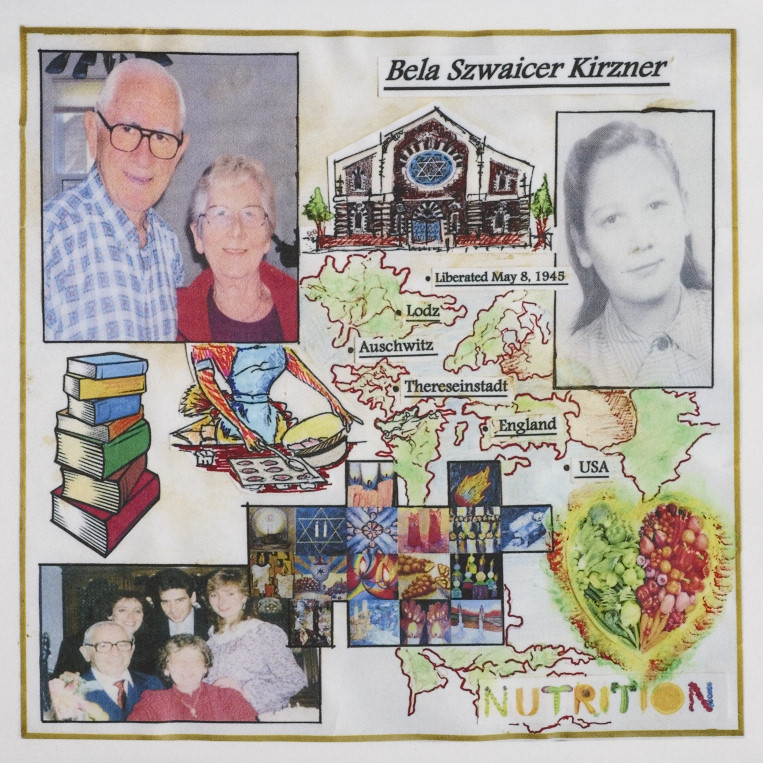
Bela Szwaicer-Kirzner

tbmq-061

I was born March 15, 1929 in Lodz, Poland. I was interned in 4 concentration camps. The first one was ghetto Lodz for 4 and one half years. In August 1944 the ghetto was liquidated and my family and I were taken to Auschwitz where I lost my whole family. After 10 horrible weeks, I was selected to go to Germany to work in an ammunition factory. In March 1945, they put us in open coal railroad cars and shipped us to Theresienstadt, Czechoslovakia. We were liberated by the Russian Army on May 8, 1945.

In August 1945, 300 of us boys and girls were sponsored by the Jewish Committee to go to England. We arrived in Windermere and I lived in Manchester until July 1947. Then I left for the U.S. and lived in Boston with my relatives. I went to High School and Hebrew College. I met my future husband Rubin, and we were married on November 5, 1950. We have 2 daughters, a son and 2 grandsons.

I have chosen the square because it represents the past of myself as a teenager, and the present and future of my family. It symbolizes my interest in books, baking and keeping up my Jewish Heritage.

.

‘ ‘