Steven Pearl

Steven Pearl

tbmq-102
The making of Steven Pearl’s quilt square – I have to say, it has been tougher than I first thought. Whilst wanting to create a celebration of our father’s life and keep to the positives, sadly the Holocaust and its effects on his spirit have very much affected his life. When we were young he did not speak of it at all and we only learnt from our mother of the terrible atrocities that he had witnessed and suffered. However, later in life, he has spoken about it much more and it was often on his mind, so we felt that some mention of those he had lost and those who had miraculously survived had to be incorporated.
The photograph of our parents’ wedding day and the mention of his family were essential as he was a very proud husband and father. The strong yellow sun is there because Dad has always loved the sunshine and was happiest visiting our family in Israel, going to the beach or staying at Lake Kinneret with them all. The bracelet represents his profession as a jeweller; he worked for the same small company in Hatton Garden for many years until he retired.We are more fortunate than some of the second and third generation in that our father is still with us (we lost our mother to cancer some 19 years ago) but sadly – due to his advanced state of dementia – his memories and his recognition of his family and his friends, especially ‘The Boys’ that he has been so close to for all these years, has gone and so working on this square has been particularly poignant for me. The commemorative memory quilts are a wonderful idea and our family are very happy to participate and hope that the quilts will be a lasting tribute in some small way to the many that suffered in the Holocaust.

Kim Fleming

‘ ‘

Issaak Pomeranc

tbmq-061

Our father Issaak Pomeranc was born on 2nd March 1928 in Dzialoszyce, Poland. In 1941, aged 13, he was taken to the town’s ghetto and from there to Plazsow concentration camp. During the following 4 years he was taken to a further 6 camps and then on a death march to Theresienstadt, where he was finally liberated in May 1945. He was brought to England later that year and stayed in Windermere where he recuperated and learnt English. He travelled to Israel in 1947 to be reunited with his only surviving brother and the picture of him on the quilt square was taken whilst he was a volunteer in the Israeli war of independence in 1948.The square depicts his early bleak years in the camps as the roots of his family tree. From desperate beginnings he never despaired and his family tree flourished. From us two children he had six grandchildren and now two great grandchildren as well. His legacy lives on as the tree grows and his love and devotion to his family and fellow survivors continues to inspire us all.

Denise Pearlman (nee Pomeranc) and Stephen Pomeranc

Arthur Poznanski

Arthur Poznanski

Our father Arthur Poznanski was born on November 7 1927 in Praszka, Poland. He worked in the Hortensia glass factory, in Bugaj as a joiner, and went through the camps at Buchenwald, Schlieben, and Flossenbürg. He escaped by jumping from a train that was transporting him to Mauthausen in 1945. On landing he was shot by a guard and left for dead but the bullet hit the spoon he was carrying in his pocket. He managed to crawl to a Czech village where he was hospitalised. He found his brother, Jerzy, in Theresienstadt and was brought to England in August 1945 where he started a new life first as a professional singer and then worked in the textiles industry. He married Renee Rudolf in 1960. He passed away August 10 2009 and is survived by two children and four grandchildren.

Arthur had an exquisite voice, and found joy and comfort in music throughout his life whether singing, composing, playing the piano, or conducting the local synagogue choir. That is why we filled the square with so much music. The interspersed images of glasses represent both the glass factory and his celebration of life in freedom, and of course we had to include images of a spoon.

Angela and Victor Poznanski

Josef Perl

tbmq-064
JOSEF PERL was born on 27 April 1930, in Velicky Bockov, Czechoslovakia, the only son of Frieda and Lazar Perl. He had eight sisters. His journey through the camps included Krakow-Plaszow, Auschwitz-Birkenau, Dachau, Bergen-Belsen, Grossrosen, Bolkenhain (a subcamp of Gross-Rosen), Hirschberg and Buchenwald, from where he was liberated in April 1945 by the Americans, 16 days before his 15th birthday.
The concept for Josef’s square is that of a fictitious letter, written to him by a young pupil after a visit to her school, where he told his story. He visited thousands of children at schools throughout England and received innumerable letters from them. The images on the quilt depict his life after the war and represent the fact that the Nazis could not prevent him from leading a fulfilled and happy life.

The dog was Josef’s pet Alsatian, Bondie, shot by Nazis in front of the family when soldiers came into their home to terrorise them. The horse was his pet, Sharrie, taken away that same night. Josef would ride Sharrie to school bareback, with Bondie leading the way. Both would return to school to collect him at home time.

The Union flag commemorates his arrival in England, where he learnt a new language and started his new life. The cutting shears, tape measure, thimble, buttons, spool of thread and dressmaker’s dummy symbolise the trade of dress designer and pattern maker he learned as part of his rehabilitation. The wedding rings represent his marriage to Sylvia in Brighton in 1955.The spade and the family’s Sefer Torah are central to Josef’s story. Originally acquired by his great-great-grandfather, it was buried in 1938 to keep it safe from the Nazis. Unknown to Josef, his father had also survived the war. On returning home, Lazar dug it up and, after emigrating to Israel, gave the scroll to Josef who undertook its complete restoration. The jacket and silverware incorporate the names of the family who perished. It is still in continual use.

The ‘Hotel Full’ sign represents the 22-bedroom ‘Sunnyside Court Hotel’ they had in Bournemouth (hence the yellow sun). It was always with joy that they put up the ‘Hotel Full’ sign. The pearls represent our surname, Perl, and come from a dress of Josef’s grand-daughter, Ella.

The family silhouette depicts three generations: (L to R) Frances, Sylvia (always at his side), Josef, sitting down, and baby Ella, on Josef’s stiff leg, the leg being used as a see-saw. Shot by guards whilst escaping from one of the camps, a bullet lodged behind his left kneecap. After surgery in England the leg was saved but the knee joint was fused. The blue edge represents the blue on the Israeli flag and the blue stripes on a tallit, the traditional Jewish prayer shawl.

Mark Perl & Frances Kahan

David Peterson

tbmq-030
Born David Pietrkowski on 17th October 1927, David lost all his family in the ghettos and concentration camps in Poland. When he was liberated and alone in the world at the age of seventeen he came alone to England to begin a new life.


These family photos will always remind me that out of the ashes of Auschwitz and Bergen-Belsen David created a new family, a second and third generation who would remember these atrocities. These are living proof that good will overcome evil.

Anne Peterson

Mendel Preter

Mendel Preter

I was born on October 7th 1927 in a small village called Czermnika near Lublin in Poland. Towards the end of 1942 when I was 15 years old I was taken to work in a distillery not far from where I lived which was run by the SS. All my family were taken away to Treblinka except my father and one of my brothers who also joined me at the distillery. We produced alcohol which fuelled the rockets for the German war effort. In May 1943, after the Warsaw uprising, we were taken to Majdanek and then, together with my father to Skarżysko-Kamienna which was an ammunition factory. I worked at producing anti-aircraft shells. After a year, in 1944, as the Russians were approaching we were sent to Częstochowa where I stayed for 6 months. I was finally sent to Buchenwald in January 1945 and then taken by train for 4 weeks, from April to May, to Thereisenstadt where I was liberated on the very same day I arrived.

I was brought to England with the first group of Boys in August 1945 (the day the Japanese surrendered) and taken to Windermere but I was immediately sent to hospital because I had TB of the spine and chest. I spent four months in the hospital in Windermere and was then sent to another hospital in Ashford for three months. I spent four years lying flat on my back on a frame recovering from TB in a hospital in Alton, Hampshire. When I finally recovered in 1951 I went to Quare Mead, a convalescent home for the Boys, where I stayed for 4 months until its closure.

I was still wearing a metal brace when I went to stay with my friend Mendy Teichman in London. I stayed in the same house as him as a lodger until he got married and moved out. One of the Boys, Haskel Schlomovich took a job in an accounting office, I didn’t know what it was but I thought if he can do it I can do it too so I applied to be a junior accountant. My first duty was to make tea, I learnt how to warm up the pot, how long to brew the tea. I made tea for all eleven people in the office and they all said it was the best cup of tea they had ever had and so they kept me in the office as long as I made tea. And that is how I became an accountant. I worked for the same firm from 1951 to 1964 when I went to America. I continued to be an accountant for the rest of my life. I moved to Miami with my wife and two kids where I still live and where I worked as an administrator/accountant in a nursing home for 28 years.

The square shows me and my two dear friends, Sam Dresner and Alf Huberman on the beach in Miami – one of my favourite places.

‘ ‘

Michael Preston

Michael Preston

I was born on 30th June 1930 in Lodz, Poland. My parents and my sister lived in the Lodz ghetto. My father died in the ghetto. The rest of the family ended up in Auschwitz where my mother and sister died. I then went to Buchenwald and finally Theresienstadt where I was liberated in May 1945.

I came to England with the first group of Boys in August 1945 and was looked after in Windermere. After I moved to London and made a new life working as an accountant and eventually set up my own business.

My friend, Dr Rosemarie Bailloud, made the square for me and decided to make it look like books because I have always surrounded myself by books and they have always formed a major part of my career.

Nathan Pivnik

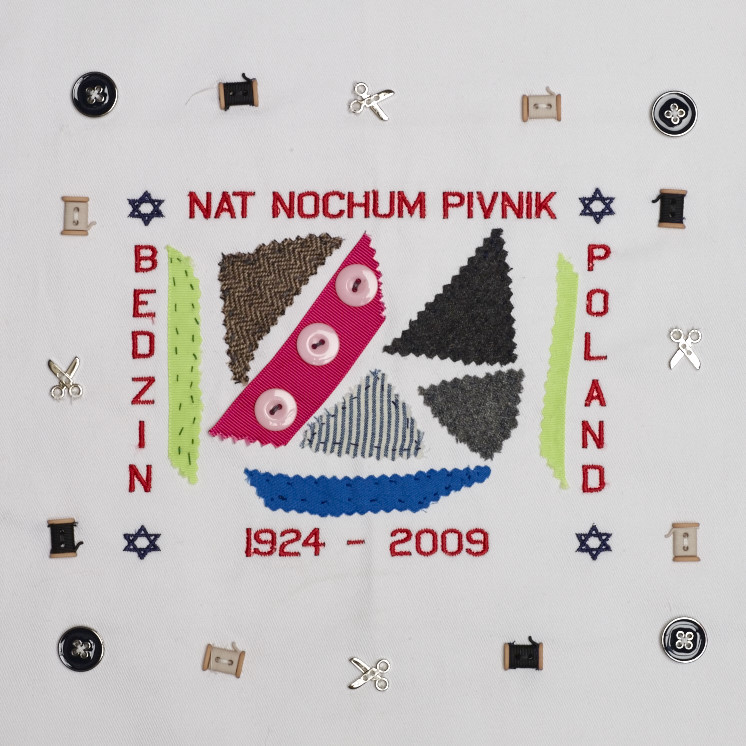
tbmq-144Nathan (Nat, as he was known) was one of seven children born to Fajgla and Leib in Bedzin, Poland. He had two sisters and four brothers. His mother Fajgla was 38 years old and his father Leib was 49 years old. His sisters Handel 21, Hanna 13 and his brothers Mayer 16, Wolf 8 and Yossel 6, were all gassed in Auschwitz in August 1943. Only Nat and one brother survived the holocaust.


In 1947 Nat arrived in London and stayed with an aunt and uncle. He became acquainted with some of ‘the Boys’ in Stamford Hill and soon became one of ‘The Boys’ himself. He studied his trade as a gentlemen’s tailor from his father in Bedzin. He commenced his working life in London’s West End in the tailoring trade. In later life he decided to work for himself at home, which included garment alterations for both men and women. Hence you will note the swatches of material, buttons, cotton reels, scissors, etc. on Nathan’s square.
Sadly we were not blessed with our own children. However and thankfully we have our family who live in Ramat Gan, Israel, all of whom also became Nat’s family. He loved his brother-in-Law, sister-in-Law, nephews and niece. We visited each other often. He will always be remembered and loved by his ‘family’.

Jill Pivnik

Alexander Riseman and Yitzhak Rajsman

Alexander Riseman and Yitzhak Rajsman

Alexander and Yitzhak Rajsman were born in Lodz, Poland. They had a sister called Rochel who died in the camps. Their parents Lea and Pinchos also did not survive.

After the war, the two brothers came to the UK with the Boys and stayed in Windermere. Yitzhak later settled in Israel and kept the original spelling of their name.

My father, Alexander Riseman, was a men’s tailor who believed in staying religious so the square includes a man’s suit and a Sefer Torah to signify frum Jewish life which he instilled in his family.

Helen Meyer nee Riseman

Joe Rents

tbmq-061

Born Jozek Ratziek in September 1929, Joe lived in Rzeszow, a town near Krakow with his family. They were all made to live in the Krakow ghetto prior to the Plaszow work camp in 1942. They were then transported to the concentration camp at Auschwitz where all his family perished.At Auschwitz, having been tattooed with the number B-4179 on his wrist, he was set to work in the camp with survival being the main objective. Joe was only about 12 or 13 years old and was aware that every day, early in the morning, the soldiers would come into their bunk sheds and select people for extermination. Joe always awoke very early and hid so that he could not be seen for selection.

Some time later, the men and boys that were fit enough were marched for several weeks to another camp at Buchenwald. From here, Joe was ordered onto one of many open truck trains, packed in like cattle, to make the long journey to another camp, braving the freezing rain and snow 24 hours a day and several weeks later, those that survived arrived at Theresienstadt in Czechoslovakia.

On leaving the train, Joe saw Stanley Faull (Salek Falinower), left for dead. As he recognised Stanley from Buchenwald, he rounded up a few others to help him. Thus began a long and special friendship. At Theresienstadt it wasn’t long before the camp was liberated, the German soldiers fled and the Russians came to their aid.

In August 1945, Joe and Stanley arrived in Windermere. Stanley went to stay with relatives while Joe lived in various hostels in London and performed at the Yiddish Theatre in Whitechapel. The photo shows Joe as a young man with another survivor, Ziggy Shipper; Joe is on the left hand side.

In 1951, Joe visited Brighton where he met Renee and married in 1954. He became a successful businessman, manufacturing ladies coats. The label Kashmoor and coat image symbolize Joe’s business success. Joe and Renee have three children: Lorraine (Ellie), Michael and Benice, and eight grandchildren. The photo shown was taken on their 60th Diamond wedding anniversary in July 2014.

Ellie Cave