Sam Pivnik

Sam Pivnik

Sam was born on 1st September 1926 in south west Poland in Bedzin, near the German border. In 1943 his family was sent to Auschwitz/ Birkenau. His father, mother, 2 sisters and 3 younger brothers were murdered. An older brother and Sam were the only survivors. He was sent to work on Auschwitz’s Rampkommando where prisoners were either selected for work or gassing. He then worked at Furstengrube mining camp. As the Third Reich collapsed, he was sent on the Death March that took them west, and was liberated in Neustadt in 1945.

Sam was one of a handful of people who swam to safety when the RAF sank the ship Cap Ancona carrying survivors after the war – mistakenly believing it to be carrying fleeing member of the SS.

Smuggled in to Palestine, Sam fought in the War of Independence in 1948 and was very proud to receive a certificate from Yitzak Rabin for his service.

Sam settled in London with his brother and bought a house which he shared with his brother and his wife. He built a life as an Art Dealer and ran a gallery in Notting Hill. Sam shares memories of his experiences through lectures and talks and wrote his memoir ‘Survivor’ as a record of his life and the Holocaust.

Barbara Jackson

Baruch Pollak

tbmq-141Baruch Pollak (Vojtech bela) was born in Miskolc, Hungary. His father was a tailor, his mother was a midwife. His mother was from Jasina and as a toddler my father, his two older brothers and his parents moved back there. Jasina is located in the Carpathian Mountains set in a valley surrounded by beautiful mountains.


On the day after Passover 1944, the Jews of Jasina were rounded up in the center of town and taken to a ghetto called Mateszalca in the Satmar region of Hungary. They remained there in deplorable conditions with thousands of other Jews for a period of four weeks. At that time they were loaded onto boxcars and taken to Birkenau, Poland – Auschwitz! From there my father was transferred to other concentration camps: Mauthausen, Melk and finally ended up in Ebensee where he was liberated by the Americans. At that time he was reunited with two uncles and a cousin, the only survivors in his family. They lived together in the Sudetenland until my father was able to join a children’s transport hoping to end up in Israel. He arrived in London and was housed in a shelter in the East End of London. He was part of a large group of survivors called “The Boys” of the ‘45 Aid Society. Thus began his new life. He met and married my mother in 1948. He worked very hard and lived for his family. My father had a big heart and was a warm, loving and very generous man. May his memory be a blessing for us all.
We chose to highlight his family tree on the quilt square in honour and in memory of those lives lost in the Holocaust but also to recognize the potential loss of future generations that would have been born to our family.

Sharon Pollak

Lili Pohlmann

Lili Pohlmann

Lili was born in Lvov on March 29, 1930 and lived in Krakow, Poland with her parents Cecylia and Filip Stern and brother Uriel. Her father was a bank manager and her mother was a dress designer. As a child, she loved spending time in the main park in Krakow, riding scooters, climbing trees and eating freshly baked bread and sausages with her father. She also enjoyed family visits to Lvov and skiing holidays in Zakopane. During the Nazi occupation of Poland Lili and her family were in Lvov and only she and her mother survived.

Their lives were saved thanks to the exceptional courage and humanity of two remarkable non Jews: one was a German woman, a civil servant attached to the Nazi occupying forces in Lvov – her name was Irmgard Wieth and the other, a Ukrainian, the Greek-catholic, Archbishop Andrey Count Sheptytsky. On 29th March 1946 Lily arrived in London in the first of the three transports of Jewish children brought over from Poland by the indomitable Rabbi Dr Solomon Schonfeld, Z’l whose inexhaustible efforts to rescue the remnants of those children who survived gave them a new life and freedom in this country.

For the past 20 years, Lili has dedicated herself to building bridges between the Polish – Jewish community. Her passion for forgiveness and gratitude to the people who both persecuted and saved her, has made her a much sought after speaker, from schools to embassies. In 2007, her tireless work earned her one of Poland’s highest accolades, The Commander’s Cross of Polonia Restituta, awarded for extraordinary and distinguished service.

Lili has a lifelong deep love for opera, music and the theatre. She strives to make sure the survivors’ legacy is heard as well as those brave people who risked their lives to save Jews. She was very close to Nobel Peace Prize nominee Irena Sendler, who saved 2,500 children from the Warsaw ghetto. Lili speaks often of Mrs. Sendler’s legacy: “If Steven Spielberg would have heard of Irena Sendler first, it would have been “Sendler’s list,” not “Shindler’s list.”

Lili’s laugh is unique to her and she brings light and hope into a story that is dark and horrifying. She is adored by her daughter, Karen and her legacy… her 3 grandchildren, Corey, Daniel and Kaelin.

Karen Mantell

Jack Rubinfeld

Jack Rubinfeld

My husband Jack was born on December 3, 1928 in Bircza, Poland. In Spring 1942 he was taken to a work camp in Przemyśl, Poland. From there he went through Rzeszów, Oranienburg and Herman Goering Werke and several transition camps until he was finally liberated on 2nd May, 1945.

He was brought to England near the end of 1945 and stayed in Winchester for a few months. Then, Jack went to Northampton. In the summer of 1947, he went to London where he lived with about three different families. Jack finally moved to the US in 1949 and eventually became a builder.

Jack’s granddaughter, Orly Rubinfeld, helped design the square. The square represents Jack’s family tree. I have chosen Bircza as the roots of the tree where Jack was born and where his family lived. To pay tribute to and to remember Jack’s immediate family, his parents’ names appear at the top of the tree, and each sibling appears in a tree’s branch.

Rivka Rubinfeld

Yisroel Rudzinski

tbmq-050Our beloved Zeide was absolutely adored by each and every one of his grandchildren. His care and concern for each was indeed rare. Where would one find a grandfather who knew exactly what each of his grandsons was learning in cheder?! Where would one find a grandfather who would seriously review each one of his grand-daughter’s tests – and reward them accordingly?!
Indeed Zeidy was a grandfather who lived for his grandchildren. But his “grandfatherly” duties did not end with his grandchildren. Reb Yisroel was the Zeide of the street. Upon seeing Zeidy the little children would stretch out their little hands, waiting for the goodies that Zeidy so lovingly doled out.


The little boys in the streets were enquired about their studies too, and yet again, the little bag of goodies would reappear again, much to the delight of the little kinderlech.
Zeidy dear – it’s not only us grandchildren who miss you dearly, it is all the Kinderlech who came into contact with you, they miss you too!

Thea Rudzinski

Jack Schwimmer

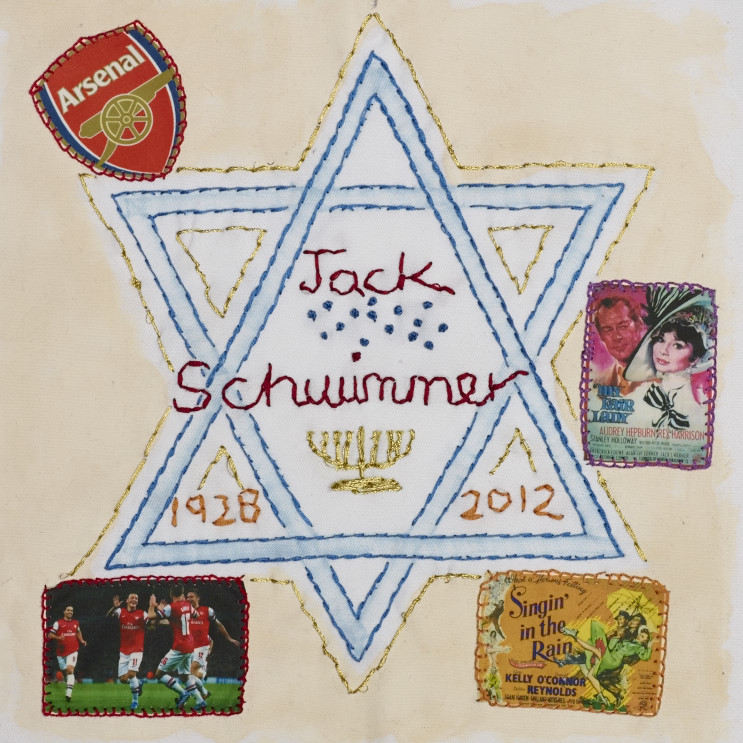
tbmq-129Our father Jack Zisha Schwimmer was born on 5 April 1928 in Stróżowska, a small village about 2 kilometres from the town of Gorlice, Poland. During the 2nd World War he spent three years being interned in six different camps, including Buchenwald. He ended up in Theresienstadt where he was finally liberated. He was then brought to England and started a new life. He worked as a tailor, salesperson and a manager and eventually became a husband and father.
The square represents something of his life and we have chosen these subjects because of his love of Judaism, old musicals and his later interest in Arsenal. He also looked after his family and home immaculately.

Gary Schwimmer

Genia Schwarzmann

Genia Schwarzmann

Our mother was born on 23 January 1934 in Radom, Poland. She was smuggled out of the Radom ghetto in July 1942 and taken into hiding. First in the countryside and then moved back to Warsaw where she remained hidden till March 1945. She was brought to Israel October of that year where she stayed on Kibbutz Gan Shmuel till 1948. She then served in the army and latterly studied at the old Hebrew university. In 1956 she came to London to study. She married David Schwarzmann in 1960 and remained in London. She has 4 children and 11 grandchildren.

The square represents the miracle of her survival particularly through her grandchildren who bring her so much happiness, nachos and pride.

Shelly Simons

Josh Segal

tbmq-018
Born Jehoszua Cygelfarb in Lodz on 24 December 1926 to Avrom Kalman, a self-employed painter and decorator and Pessa, Josh had 3 sisters, Sarah, Rachel and Mindy and a brother, Wovek. In September 1939, the Germans moved into Lodz so the family went to the ghetto in Piotrkow Trybunalski.

At 15, Josh and Wovek 19, worked in the Hortensia glass factory in Piotrkow. They were separated from their family, never to be seen again. As they headed by train toward a labour camp, a worker found a piece of paper dropped by Josh’s father. He wrote that the brothers should take care each other and fight for their lives. On November 25 1944, Joshua and Wovek arrived at Czestochowa labour camp and stayed until January 17 1945. They were then taken from Buchenwald to Nordhausen. Each day, prisoners were taken to Dora Mittelbau, a large underground factory for manufacturing bombs and rockets. Josh worked in the staff kitchen where the officers ate and was able to supply extra food for his brother.

After the war, Josh ended up in Prague, looking for family. Wovek disappeared, feared dead. Josh registered at a Jewish orphanage and was brought to Alton in England where he lived in Overbury Court hostel. He was taught to work with wrought iron and then moved to Bedford, where he was an apprentice mechanic for Rolls-Royce automobiles. An uncle from Nottingham found him and gave him names of relatives in Canada and Paris. He contacted his aunt in Paris, who told him that Wovek was living there with her.Joshua made his way to Canada, arriving in Halifax on the Ascentia on 27 December 1947 with 700 war brides. He became a greeter for the Hebrew Aid Society for Holocaust survivors and brought Wovek and his wife over from Paris. Joshua married his beloved wife, Malka Rae, in 1953. Founding members of the Beth Emeth Bais Yehuda conservative synagogue in Toronto, he is still a member. They had 4 children, Keith, Lloyd, Paul and Sharon.

Joshua was owner and president of Paris Sportswear. Sadly, he lost Wovek in 1993 and Malka in 2012. Today he has nachos from his children, 9 grandchildren Beth (spouse Sean), Sean, Jaime, Jeffrey, Brian (spouse Samanatha), Samantha, Brandon, Nicole and Amanda, and 2 great grandchildren Tyler, Zachary and one on the way. Josh said, “What happened to us cannot be buried.”

Sharon Segal

Leon Rosenberg

Leon Rosenberg

Our dear father Leon Rosenberg was born just outside of Ostrowiec, Poland, on 15th May 1927. In 1940, when he was 12, he and his family were forced to live in the Ostrowiec ghetto and shortly after, they were all transported to concentration camps at Buchenwald and then Treblinka. During 1942, he and his family were taken to Auschwitz, where he witnessed the murder of his own father. Leon was eventually liberated by the Russian army in Jan 1945 and then when he was 18, he was taken to Windermere in England. There he was taught to read, speak and write English and he was also trained to design and make furniture. He spent most of his working life in the furniture industry in London. He married Vicky Jacobson in May 1948 and they had two sons, Alan and Max. Leon sadly died in November 2007 aged 80 but just before he passed away, he told his sons that he was a lucky man and had been blessed with an extra 65 years of life. He never expected to survive Auschwitz death camp.

The rose represents the ecstasy and agony of life and also links to the name Rosenberg, which means ‘mountain of roses’. The blue sky represents a world full of light, free of clouds and free from darkness. The rainbow is a symbol of hope and optimism for the future. The butterflies at each end of the rainbow represent Israel and Britain. Leon was eternally grateful to the Government and good people of Britain who offered the survivors the unique gift of a second chance at life. Likewise he was so happy when the state of Israel was established in 1948 as a home for Jewish people.

Leon loved to travel and particularly by aeroplane as this was the ultimate feeling of freedom. For five years of his life, 1940 to 1945, he never saw a single flower and so loved gardening and growing flowers. Fishing was a favourite hobby and he especially enjoyed catching pike and carp for making gefilte fish.

Max Rosenberg

Leo Robeson

Leo Robeson

tbmq-061

Laib Rozensztrauch was born on 27th February 1924 in Lodz, Poland, into a close knit family. He had an older brother Abraham, an older sister Sura and younger sister Raca Gita. Miraculously he survived both the ghetto and Auschwitz, where he was sent in August 1944 and liberated by Russian troops on 27th January 1945. Like many survivors, he returned to his former home, now occupied by a local family, only to have the door slammed in his face.He ended up in a displaced persons camp in Cremona, Italy. His name was seen on a list by an uncle from London who arranged for him to come to England. He worked for his uncle, changed his name to Leo Robeson and married my mother in 1956.
The square has been designed with my daughter Talia and represents his family and legacy. My father immersed himself in his work as a rag merchant and devoted himself to his family, rarely opening up and talking of his life before and during the war. It was too painful and traumatic.
My father died in 1994 and around 10 years later, my sister Suzanne began investigating whether any family records had survived in Poland. To her great surprise, she discovered Abraham, who had gone to Russia in 1939 to find a safe place for the family, had also survived the war. He returned home from a Russian labour camp in 1946 and was greeted with the same door being slammed in his face. Neither Abraham, who died in 1989, nor my father realised the other had survived, but Abraham’s three children and their families meet with our family each year. How their lives would have been different had they been reunited!

Geoffrey Robeson