Frank Farkas

tbmq-060

Ephraim Farkas was born in Czechoslovakia in a small village called Horincova on 1st October 1929. His family consisted of his parents, Eliahu and Chana and three other children, Faiga, Aaron, and Josko.

In 1943 they were all taken to work, building new roads until Frank and his father were taken to Theresienstadt and after that to Auschwitz where they met the rest of his brothers who had fled to join the underground. He lost his parents and 2 siblings during that time and when he was finally liberated he chose to come to England under British auspices with The Boys. He was eventually taught the language and a trade. He married Carol and together they built a wonderful family with two children, Helen and Alan and had a lovely life together, until unfortunately passing away at an early age in 1986.

Our patchwork tree is a very simple representation of the birth and growth of our families. The tree trunk represents the growth of each of our parents intertwined.
The leaves represent each member of our family: me and my three children Shai, Ben and Emily and my brother Alan and his three children, Katya, Violet and Jack.

It is simple and colourful and I think it’s a good representation of our lives.

Helen Agami and Alan Farkas

Stanley Faull

tbmq-117

Stanley (Salek Falinower) was born in Warsaw, Poland on 29th October 1929, to a loving, middle class family who owned a metal foundry. He was not quite ten when war broke out and the family were crowded into the Warsaw ghetto, living in squalid conditions until the Warsaw uprising in 1943. His sister Henia left to join the Resistance and was never heard from again. His father Naftali was killed in a bunker in the ghetto. After the uprising was brutally suppressed, he and his mother Rachel were taken to Majdanek concentration camp, where his mother was murdered in the gas chambers and he worked as a slave labourer.

The top part of the panel is evocative of the Holocaust. The dark and foreboding sky epitomises the dreadful times of his early life, first in the Warsaw ghetto and then in various concentration camps, before his liberation from Theresienstadt on May 5th 1945. The clouds represent his parents and sister who were murdered in the Holocaust. The spare cloud symbolically represents the 6 million, including 1.5 million children, who also perished in the Holocaust.

The bottom half of the panel shows the other half of Stanley’s life. Like him, it is colourful and full of joy, with the rainbow colouring showing renewal, hope and in Noah’s time, a sign of God’s covenant to never destroy all life on earth.

The tree is a sign of Stanley starting his own family with three sons and four grandchildren, all of whom he was immensely proud. The Faull name, which he and his brother Gerald started, lives on as a permanent reminder of “Triumph over Adversity.” Stanley died in Hove, England on 11th May 2014.

Steven Faull

Eric Fisch

Eric Fisch

tbmq-061

Eric born on 15th Dec 1925 in Bodzentin in Poland and went to Auschwitz as well as other camps. When he came to the UK, he worked selling men’s trousers. He loved working as a market trader and did that for many years. His favourite markets were Petticoat Lane and Portobello Road.He also liked his whisky and a game of cards, so this is shown by the pub sign above the stall.
We have also put in the 3 flags: UK as he lived here since 1945 and had his family here, Canadian as he found some distant family there and was extremely pleased to visit them there. Lastly the Israeli flag as went there often and had many friends there but also was very interested in the politics there as the Jewish state, etc.

Denise Greenberg

Chaim Ferster

tbmq-061

Dad was born on July 18th 1922 in Sosnowiec, Poland. He was the only son; he had 3 sisters, 2 of whom were married with children. His younger sister Manya and Dad are the only survivors of a large extended family.From March 1943, he went through 7 concentration camps, where he experienced hell on earth. In Graditz he contracted typhus and by some miracle survived. In September 1944 he arrived in Auschwitz, which was a terrifying experience. After 6 weeks, they were selecting engineers. He immediately volunteered and after various tests, he was fortunate enough to be selected along with a few hundred others. They were loaded onto cattle trucks and after a horrendous journey on which many people died, they arrived at Niederorschel in Germany. This camp was comparatively like a holiday camp. He worked in a factory assembling the wings for Junker planes. At the beginning of April 1945, they closed the camp and all the inmates were ordered onto a Death March. Many people died and on the evening of the 10th April 1945 they arrived at Buchenwald. During roll call on the 11th April, American planes flew overhead, the German guards scattered and American tanks entered the camp shouting, “You are free, you are free!”

Some weeks later Manya, who was liberated from Belsen found our Dad and they were re-united. Thanks to their uncle, Bernard Forster, who had moved to England prior to the 1st World War, they arrived in the UK on February 7th 1946 to start a new life. In 1947 he met Nan at the Ritz ballroom in Manchester and in 1948 they married. Our parents were married for 65 happy years and had 3 sons, 6 grandchildren and 2 great granddaughters. Sadly, our dear mother passed away in January 2014. Family has and always will be our Father’s number 1 priority. Four months ago, dad retired from full time employment and to keep himself occupied, speaks to schools all over the country, educating children about the horrors of the holocaust. He has also taken up his love of playing the violin.
The square represents 65 wonderful years of married life with his soul mate Nan, his dear family which is so important to him and his new found love of playing the violin.

This project is particularly important to dad, as his greatest fear is that the holocaust will be forgotten in a few generations. Projects like this help keep the memory alive.

Stuart Ferster

Harry Fox

tbmq-061

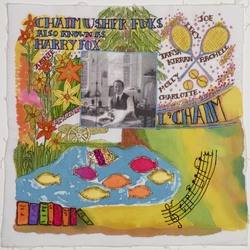
Chaim Usher Fuks also known as HARRY FOX. Harry was born on 15 July 1930 in Tuszyn, a small market town in Central Poland where his family had lived for over ten generations. In the night of 30 November 1939 all the Jews of Tuszyn were forced out of their homes and sent to the Piotrkov ghetto. Various Slave Labour Camps and Concentration Camps were to follow, including Buchenwald and Nordhausen. He was on a Death March, which lasted over three months. 45 out of about 3,000 marchers survived to enter Theresienstadt where they were liberated by the Russians three weeks later, on 8th May 1945.A few weeks after the end of the war, people from the Central Jewish Fund arrived in Theresienstadt looking for Holocaust survivors under the age of sixteen to come and live in Great Britain. They had planned to bring 1000 child survivors but they could only find 732. Harry came to England on 14th August 1945 together with his brother Harry who had also survived. They were flown here in a Lancaster bomber from Prague to Carlisle, and were looked after in Windermere. They were in the first batch of 307 orphans, who later, both boys and girls, became known as ‘The Boys.’ From there he made a new life in London where he worked as a fur cutter.
The photograph of Harry working, was taken when he was about 26 and had just set up in business on his own. The tree and lake full of fish recall the happy summer months spent with his family in the Forest of Tuszyn. Harry was fond of music, especially the Yiddish songs of childhood, opera, and Tschaikovsky. He loved singing and the Quilt piece is taken from the song ‘Because’. Arsenal’s name and canon is depicted as this was ‘his’ football team. Books were important to him and devoured chiefly as sources of knowledge. The words L’Chaim are there because he never ceased to CHOOSE LIFE. He never gave up and was always eager for new experiences.

Tennis was his passion and he played it many times a week. All around the tennis racquets are the names of his children and grandchildren. From Harry’s first marriage are Joe, Rachell, with her daughters Molly and Charlotte, Tanya, with her daughter Kirran, and from his second marriage, our daughter Lucy. My name is on the other side of the square, under the names of my beloved husband, the person I loved and will always love.
All of life was of interest to him and he loved flowers and gardens, delighting in the beautiful ones of the National Trust and others. The flowers are there for that reason, and for the reason of wanting to put on this most amazing Memorial Quilt to the family of ‘The Boys’, things of colour, things growing, things that point to those who survived the horror and who say to all future generation, the Nazis did not get us all, and we have LIVED.

Annie Fox

Johnny Fox

tbmq-061

John Fox was born Jonah Fuks in Tuczyn, Poland in 1927. He was the oldest of three children born to Joseph Fuks and Rachel Gotesman Fuks. At the age of 12, he and his family were sent to the ghetto in Pietrokow. His mother and sister were sent by train to Treblinka and never seen again. John, his father and brother Harry survived by working in the glass factories in the ghetto. The three survived several concentration camps almost to the end of the war. His father, Joseph, died shortly before liberation at which time John and Harry were separated from each other. They were individually liberated and reunited at Thereisenstadt shortly after the end of war. They were airlifted to England and nursed back to health.John married Betty Davis in London in 1953 and they emigrated to America in 1956. John worked as a tailor in Philadelphia and quickly rose up in the ranks of the amalgamated clothing workers of America Union, eventually achieving status as an international Vice President. His life’s work was fighting for workers’ rights and protecting those who were discriminated against in any way, whether it be for race or religion or gender. He is survived by his wife Betty, his three daughters and five grandchildren.

Lesley Testan

Sam Freiman

Sam Freiman
The pictures in the square represent my father Solomon “Dundela” Freiman, who was born in Jeziorna, Poland on 1st January 1926 to Josef and Etka Frajman. He had 3 siblings: Haim, Hanna and Jadzia. He was taken to the Warsaw ghetto from which he fled and survived by singing for food, in particular the song “hey la dundela” from which he gained his nickname. He surrendered to the Nazis and went to work camps at Skarzysko and Schlieben until he was liberated at Terezin.

He came to England, to the Windermere centre where the central picture was taken, and then to Ascot and London where he started working as a Furrier. He volunteered to serve in the Israeli forces following independence in 1948. The photo bottom left is from this period. Returning from Israel he met and married my mother, Sonja, and their wedding photo is top right. He worked at various trades while raising our family, as shown in the bottom centre picture. The other photos show his return to Windermere, where coincidentally there was an exhibition about the arrival of The Boys there; and his dedication of an ambulance for Magen David Adom in memory of his lost family, of which he is particularly proud.

Ben Freiman

Moniek Frenkel

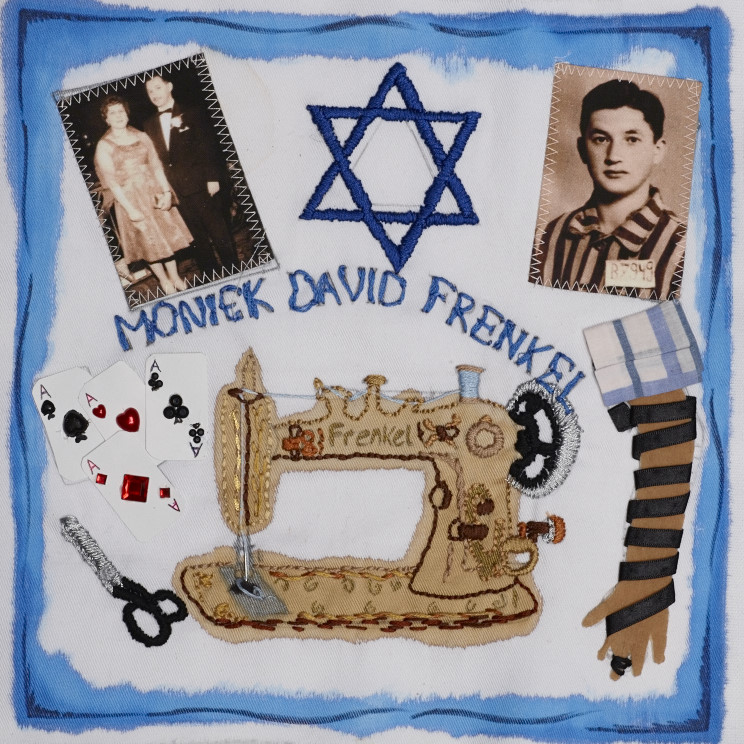
Moniek FrenkelMy father, Moniek Frenkel, was born on 24th November 1926 in Lodz in Poland. In 1941 he was taken to Auschwitz and then to Dachau until he was finally liberated in 1945. He was brought to England in 1948 and started a new life becoming a master tailor.

My mother, Esther Frenkel nee Peljord, was born on 9th February 1930 in Krakow in Poland. In 1940 she was taken to the ghetto in Warsaw and went to various slave labour camps until she was finally liberated in 1945. She was brought to England in 1949 and started a new life becoming a seamstress and later assisting my father in his business.

The square is a reminder of when my father was refreshed as a young man after the war, when he once again donned his concentration camp attire with number displayed, giving hope from his achievement of surviving. The second picture shows a happy outing for my parents at a function, as normal as any couple should be, despite the horrors they both endured separately.

Sidney Frenkel

‘ ‘

Moric Friedman

tbmq-061

My father Moric Friedman was born in Velkey Berezeni on 25th April 1931, which at the time was Czechoslovakia. He was the youngest of four children. He lived in the town of Ljuta where the family was involved in the timber business.In 1939, Hungary occupied his part of the country. They had to leave with only what they could carry and were taken to Poland. They went into hiding. In 1944 they were taken to the ghetto with a few personal possessions. In May 1944 they were taken to the railway station and put into cattle wagons. He was sent to Auschwitz, Dachau and Buchenwald. He was liberated in April 1945. Only my father and his sister Shari survived from their whole family.

He went back to Czechoslovakia, but there was nothing there for him so he came to England on June 11th 1946. He built a new life for himself as a watchmaker. He had three wives and four children. He has lived a good, long and fulfilling life. He never dwelled on his horrific start and has never judged anyone ever!

Estelle Friedman

Sam Gardner

tbmq-061

When Julia rang me and told me about the memorial quilt it was quite late in the evening and that night I couldn’t sleep. Not being in any way artistic I didn’t know what I was going to produce but I just knew that my dad was going to have a square! Luckily my sister Maralyn was coming over to stay with me the following weekend so after much discussion beforehand, when she arrived in Liverpool we got to work .First we decided on the photographs we were going to use and chose these two because the first one, taken not long after dad arrived in England shows that although he’d gained his health and strength, there was still great sadness in his eyes. The contrast of the other photograph being his wedding day and a new beginning of a new family.

Maralyn is much better than I with computers etc., so after taking a picture of the photographs we then emailed them to my computer and then Maralyn was able to transpose the pictures on to a page together with the wording we wanted. We then printed that off and drove into town. We bought a small white T-Shirt and found a shop that was able to iron the pictures and wording onto the T-Shirt. Next stop was the Haberdashery. We chose silks for sewing the border. Needles, cotton, white backing to sew it on to and for me to do the border on with holes in it so that I could do the cross stitch – scissors, ruler, pencil and rubber! We were all set.

Maralyn went back to London and the rest was up to me. I set it all out on the dining room table and looked at it and walked away from it. I did this for several days. I was afraid to start it because I was convinced I’d mess it up. After about five days I picked up the pencil and ruler, measured it out and after that there was no stopping me! Every stitch was placed with love and pleasure because I was doing it for my dad! I enjoyed every minute of it. I’m not saying it’s a work of art, but it’s mine and Maralyn’s masterpiece for our dad, Shmuel Yankel Goldberg known as Sam Gardner from Pietrokow, Poland (born 9th December 1925).

I want to thank Julia and all the team of Second Generation 45 Aid Society for giving us this opportunity to honour our father and the other survivors in this way. This was indeed an honour and a pleasure.

Estelle Fisher and Maralyn Turgel