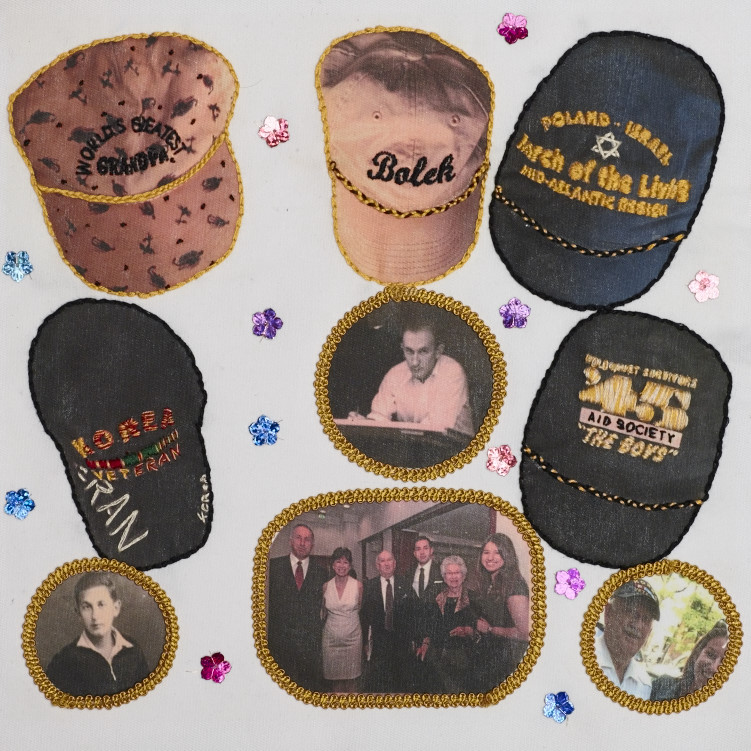
Paul Gast

tbmq-061Paul Gast (Gastfreund) was born on November 16th 1929 in Lodz, Poland. He was ten years old when his family was forced to move to the Lodz ghetto. In August of 1944 he was transported to Auschwitz with his mother and uncle. As the war intensified he was moved to several different concentration camps until he was finally liberated by the United States 82nd Airborne Division while at the Wobbelin concentration camp.

After trying to return to his homeland, Paul went to Theresienstadt where he was one of the last two children taken under the British auspices to England and became one of the three hundred plus children who were to become “The Boys”. This square represents the different “Hats” that Paul has worn in his life after his liberation from the camps. Paul continued his life in the United States as a veteran of the Korean War, an accountant, and a spokesperson on the atrocities committed by the Nazis during World War ll. Most importantly, he became a beloved husband, father and grandfather to his family.

Monica Stauber

Leo Geddy

tbmq-061

We thought about what would represent my Dad best in our square for the quilt and here are our reasons for including them.The Berwick Street sign is where he had his business for many years, but also where his cousin Paula from Ternova, former Czechoslovakia, walked in after tracing him though the Red Cross. Up until then he didn’t know that other family members had survived and was delighted that his cousin had. A German Shepherd dog, as my Mum and Dad had a love for dogs and spent many weekends at dog shows. A lion after his English name and Hebrew one too. A Rolls Royce which he loved, he didn’t really spend much on clothes or holidays but he loved his cars. It wasn’t to be flashy but I think it was more as a sign that he had made something of himself. A heart, as he had a big one and was kind and generous. A Magen David as his religion was an important part of his identity.

One of the “Boys” said to me at the Memorial Service we held for him after returning from burying him in Israel that “your Dad may have been small but he was a giant to us” and I felt that summed him up and has always stayed with me.

Madeleine Black

Sam Gontarz

tbmq-061

I, Szmul (Sam) Gontarz, was born in Lodz, Poland on 6th July 1929. My parents were Ruchela and Avraham Gontarz. I had a brother Srulek and a sister Sala. I lived in the ghetto with my family from 1940 to 1944, however in 1942 my father died of typhus. We were then deported to Birkenau where my mother and sister were taken straight away. I was split up from brother and sent to Auschwitz in July 1944 on my own. I never saw my brother again. I was sent to Mauthausen and Melk and was finally liberated by the Americans on the 8th May 1945.I spent 2 years in DP camps in Germany during which time I discovered that my sister had survived Bergen Belsen and we were reunited in early 1946. But our happiness did not last long as she was killed in a bus accident going from Feldafing DP camp to Munich in October 1946 and so I was alone again.

I was finally brought to England in July 1947 with the last transport of Boys and I came straight to Manchester where my first job was working at Jacobs the bakers. I went from one job to another and I ended up in a bag factory manufacturing handbags which I enjoyed and eventually started up on my own trading in the handbag industry and my business prospered until 15 years ago when I retired.

I married Sheila in 1958 and we had two lovely boys, Adrian in 1965 and Robbie in 1971. The square shows a picture of me in 1958 as a young groom. The palm trees remind me of Barbados, one of my favourite places, and skiing and golf which are my two favourite sports. I have played golf for many years and I used to love skiing in Switzerland, France, Austria and Italy.

I am very pleased to be part of this wonderful Memory Quilt.

Jacob Glicksohn

Jacob GlicksohnJacob Glicksohn (Glikson) was born in Czestochowa, Poland, on May 8th 1927. He used to say that because of the war, he became a man before and without having a Bar Mitzvah. During the years in the ghetto he managed to escape from selections to the death camp Treblinka three times. He was sent to Buchenwald and from there for the final solution to Theresienstadt where luckily he was liberated with the rest of ‘The Boys’.

The square has a drawing that Jacob drew during his recovery from typhus in Terezin. It resembles the desire to be strong and healthy like a lion, which can overcome the Nazi soldiers from his past. It also shows his personal number from Buchenwald, where he was told that his life was just a number, and his lucky numbers, eight and five, as his original birthday (8/5/27) and the day he was re-born (8/5/45).

In 1970, Jacob and his family left England and went to live in Israel. Jacob and his wife Margaret had two children, five grandchildren and three great-grandchildren. He lived to enjoy only his first grandson. Jacob passed away at the age of 59 and is buried in Israel.

Judy Glicksohn-Pasternak

Moniek Goldberg

tbmq-065
Moniek was born May 5th 1928. Between 1942 and 1945 he was in the following camps: Shitzke/Szyczki, Kaushina/Kruszyn, Pionki, Auschwitz, Buna, Buchenwald, Theresienstadt and Krawinkel. I don’t know if this is the exact order.He is the sole survivor of his immediate family – his father, mother and three sisters. He was brought to England from Theresienstadt with the 732 Boys to Windermere, then to Loughton and then to Belsize Park. He found various employment until he left for Canada in 1948 and worked successfully in the manufacturing of ladies clothing.
The patch states where he was liberated, our immediate family and their children. His full name is Moshe Yosef Goldberg, always called Moniek.

Fay Goldberg

Jan Goldberger

Jan Goldberger

Our father Jan Goldberger was born in Bielsko Biala, Poland in 1927. He was liberated from Theresienstadt in 1945 when he came to the UK with a young group of holocaust survivors who became known as The Boys.

Our father met our mother Sara Goldberger (then Dzialowski) who is Israeli but was working in London and they married in 1968. Family has always been very important to our father, and from arriving in England as the sole surviving member of his family, he now has three grown up children and five grandchildren. All of the members of our family are on this quilt as leaves on a tree, illustrating how the family has grown and blossomed with our parents at the centre. We have also included the entrance to our parents’ family home where they have lived since 1971. This has been a hub of our family’s life for over forty years, and continues to be filled with life and laughter from the grandchildren.

Cilla, Danny and Ruti Goldberger

Sam Goldberg

Sam Goldberg

Sam (Szmul) Goldberg was born in Bendzin, Poland, on December 25th 1929 to Zvi and Ita Goldberg. He was brought up as a Ge’er Husid, and remained in the Bendzin ghetto until August 1943. He was then sent to 6 work camps and ended up in Thereisenstadt, where he was liberated by the Russians in May 1945.

In August 1945 he was sent to England, and from there to Glasgow, Scotland. In January 1948 he emigrated to Canada, and is still living in Toronto, where he is involved in the transportation business. He owns taxi cabs and has founded his own company.

Sam and Rae have been married since 1968, and have 3 children, Debbie, Sol and Esther, and 3 beautiful grand-daughters: Shayla, Odelya and Anna.

Rae and Sam Goldberg

Monty Graham

Monty Graham

Monty Graham – father to Kelvin, Lorraine, David and Helen – was born Motek Grzmot (13.09.1926 -18.06.2009) to shoemakers Kalma and Zlata, and eldest brother to Zelek and Benek in Sosnowiec, near Katowice, Poland (picture 1).

On 6th September 1942, just seven days before his Bar mitzvah, Motek, Zelek and their father were rounded up and sent to the nearby Modrzejow ghetto.

Following transportation from the ghetto to Auschwitz in 1943, Motek was never to see any of his family again. In January 1945, Motek was part of the ‘death marches’ in retreat from the advancing Russian army. Motek only survived when soldiers, arriving at Theresienstadt in May, heard him whimper as he lay half-unconscious among the dead bodies.

Following recovery from typhus in hospital, Motek finally headed to England by military plane where he began to learn English at the Windermere hostel (picture 2) and later how to ride a motorbike at Bedford! (picture 3)

Over the next seven years, Motek became Monty and met and married Millie in London 1952 (picture 4). Together, they started a new life in typewriter repairs and greengrocery. Helping to raise four children, Monty lived to also see the birth of four grandchildren “…and getting one back against Hitler”, as he was often heard to say.

Saved photos and chosen images of Monty’s early years set among the painted flower cut outs and glittering blue sky as symbols of “joy and happiness…”

Created by the grandchildren, Jonathan Kingsley, James Gordon, Danielle Gordon and Naomi Graham.

Victor Greenberg

Victor Greenberg

This square has been put together by Victor Greenberg and his family. It represents the family that he, together with his wife Tina, were able to create after he survived the Holocaust. The richness of the tapestry reflects the happy and full lives that the family have enjoyed together.

Victor was born on 27 August 1929 in a village called Majdan, which at the time was part of Czechoslovakia. He was taken to Auschwitz in May of 1944 with his mother, father, sister and two younger brothers. He was subsequently moved to camps at Mauthausen, Gusen and lastly Gunskirchen, where he was liberated in May 1945 by the US army. Only he and his sister survived from his immediate family.

After the war he was brought to the UK where, after serving in the Israeli army during the war of Independence, he finally settled. He married Tina in 1962 and they are the proud parents of three children and grandparents of nine grandchildren.

The four corners of the quilt are marked by symbols that reflect the most important features of Victor’s life, namely, life, Jewish Customs and Israel.

Tina, Alan, David and Naomi Greenberg

Henry Green

Henry Green

Henry was born in Strzemiesszyce, Poland, on 15th July 1928. After surviving the camps, he came to Windermere, England, in 1945. He later worked as a teacher and married Angela and had one son, David.

A much loved husband and father, he was never happier than when skiing or playing tennis. As a result he was one of the founding members of two tennis clubs, keenly believing that sport was a great meeting ground for people from differing backgrounds and beliefs. Firstly the Globe tennis club in Belsize Park, North London which became a second home for many people living nearby and then after moving to Dedham on the Essex Suffolk border he again founded a tennis club here, this time aiming at local families and again still very much a well used community amenity… hence the tennis clubs and balls on the quilt square as well as details of his small family. When younger his energy was palpable.

Angela Green